Showing posts with label reading. Show all posts

Monday, March 13, 2017

Book Review: The Jelly Donut Difference

I don't know if it is the Michigander in me that automatically fell in love with this book or the amazing lesson it teaches, but this is a must for every family and classroom library.

Award-winning author, Maria Dismondy inspires
lives through her poignant stories about topics
challenging today’s modern child. Maria’s
background in early education and commitment
to teach the importance of character building
enables her to touch lives the world over while
touring as a public speaker in schools, community
forums, and at national conferences. Maria’s eighth
book, The Jelly Donut Difference, drives home the
important message of generosity and kindness.
She included the polish donuts as a nod to her
heritage. When Maria isn’t writing, she can be found
embarking on adventures throughout southeast
Michigan and beyond, where she lives with her

husband and three book-loving children.

Thursday, February 16, 2017

Word Buddies: Part 2 Blends

It is always a great find when you have one resource that continues along with your students as they grow and develop in their learning.  That is why I am still loving the Letter Buddies series, from Hameray Publishing.

You can read all about how I used the first stage of Letter Buddies with my developing readers here.  We have since moved into blends, which is huge for my readers!  I am so proud of them and the connections that they have been making.
The blends books that are the next stage in the Letter Buddies series, by Hameray Publishing, are the perfect bridge to sight word development that all developing reading must achieve.

Just like the first stage, the blends books, have a sight word reader and a pattern book that go together.

After reading and reviewing the sight word book, my kiddos practiced building the words and finding connections between other words that they have learned.

They then applied these new words to the pattern book.  The successes they have with the pattern book are incredible because they are familiar with the words, thanks to the sight word reader.

If you haven't checked out the Letter Buddy series, from Hameray Publishing, get on it.  I cannot say enough great things about these books.

What is your favorite tool for supporting your developing readers?  Leave a comment below.  I would love to hear from you.

Saturday, February 4, 2017

Nonfiction Text Features: Diagram Lesson

Teaching and studying nonfiction is one of my favorite units to expose my students to.  I love that we get to take all of the foundational reading skills that they have developed and blast off to the next level of learning.  We are no longer just reading to enjoy books, but we are reading to LEARN and grow as learners.
This past week, we spent time learning about diagrams and captions.  These two features are packed with information so we spent several days really diving into them.  Much of our nonfiction reading has been done through National Geographic Kids and Hameray Publishing.  They both have an immense library of nonfiction readers that are perfect for my firsties.
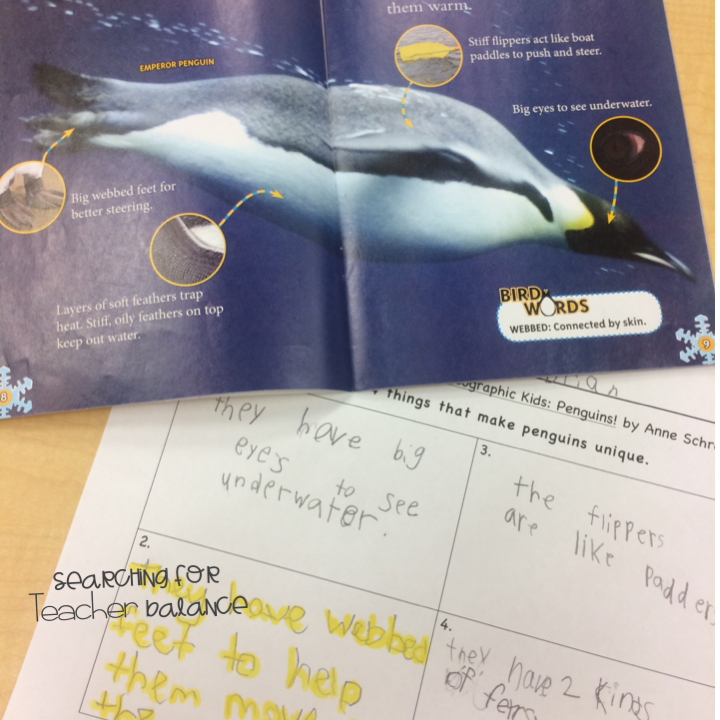
For this particular lesson, we used Penguins from National Geographic Kids.  The students worked in teams of 4 to read and discover 4 traits that make penguins unique.
The focus was not on the entire book, but just on the diagram of the penguin.  Students worked to read and summarize their findings.  They took turns recording their discoveries in a 4 box.  You can grab a copy of it here.  I also included a general version that could be used with any other animal or plant diagram.

What is one of your favorite nonfiction text features to teach your students about?  Leave a comment below and let me know.

Thursday, February 2, 2017

Joy Cowley Classroom Giveaway

It is my favorite time of year!!  It is Joy Cowely Giveaway Time!!!  
Click the image to enter
The Joy Cowley Classroom Giveaway by Hameray Publishing is here! One lucky classroom will win an entire set of Joy Cowley Collection leveled readers (60 books), Joy Cowley Early Birds lower-leveled readers (45 books), all of her newest big books (34 big books), a set of finger puppets, and more!
Click the image to enter

These books pull in even the most reluctant readers with their humor and whimsy. Your students will clamor to keep reading about their new friends: Mrs. Wishy-Washy, Hungry Giant, the Meanies, and more. Recurring characters make them reach for the next book, and playful storylines lead them to finish it. All books in this package are written at guided reading levels C–I. Read more about the books included here.

This contest is closing February 28, so enter now! Winners will be announced March 1.  Be sure to tell your teacher friends to enter, this is not a giveaway you want to miss out on.
Click the image to enter
Who is your favorite Joy Cowley character?  Leave a comment below and let me know.

Wednesday, January 25, 2017

Word Recognition with Letter Buddies

Teaching word recognition to developing readers can have its ups and downs.  I swear there are days when my kiddos are on it, they are recognizing all their sight words, and then POOF! the next day it is all gone.  I decided to try out the Letter Buddies series, from Hameray Publishing, with my developing readers.
According to Hameray, "This product line supports the development of letter knowledge and early literacy skills through letter recognition and formation, letter-sound correspondence, phonemic awareness, vocabulary development, and oral language development." I couldn't agree more with this statement.  Right away my readers started building letter recognition that they struggled with prior to using this series.
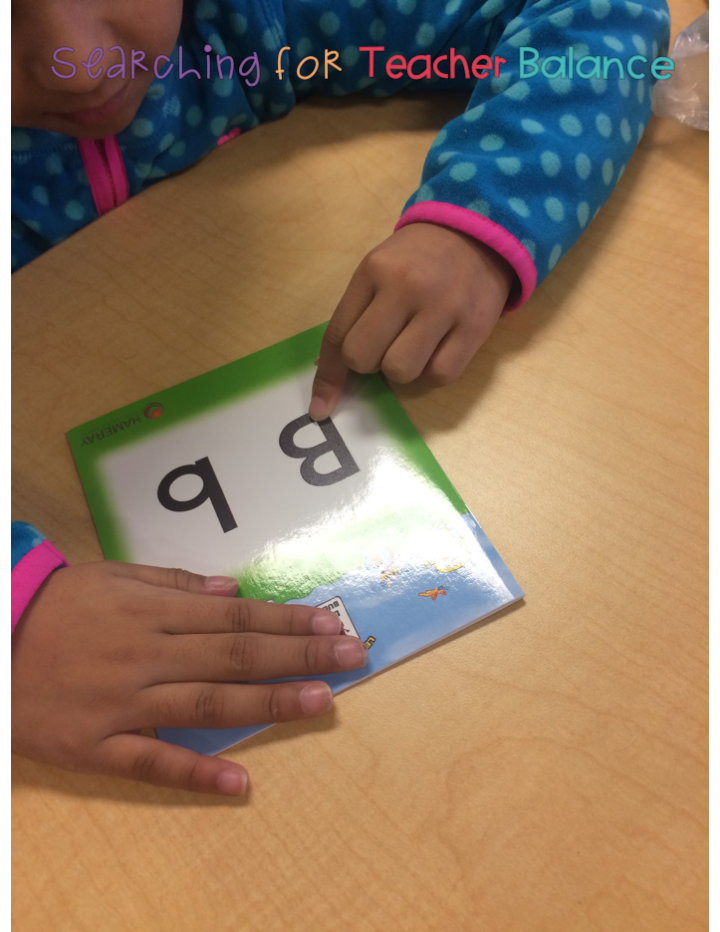
First of all, I love that the letters on the covers of the books are printed in a raised text.  My kiddos were able to "feel" the letters before diving into the books.  By using their kinesthetic sense, we began building a muscle memory that is vital for learners.
So each Letter Buddy has a book and a starter that go hand-in-hand.  We started with the letter books and practiced our letter and whole word recognition.  This allowed my readers to begin connecting the inital letter throughout the book.
After spending time with the letter book, we reviewed the words, generated a few more, and started gaining more letter and sound connections.  It was amazing listening to my readers as they inquired about their learning.  One of my students, who has really struggled with letter recognition, asked "Why do all the words have red letters?"  This is HUGE!!  He took his learning past letter recognition to word recognition.
Once my readers showed an understanding of the letters and their sounds, we dove into the starter books.  These pattern books take the words that students practiced in the letter books and place them in an early reader.  These pattern books allow for students to continue to build on their letter and word recognition, while gaining fluency and accuracy with more sight words.
I am so excited for my readers and the skills that they have gained.  I cannot wait to use the Letter Buddies Blends Books with them!
Have you used Letter Buddies with your readers?  What are your favorite resources for teaching letter and word recognition?  Leave a comment below and let me know.

Wednesday, January 18, 2017

Running Records In My Pjs

Running Readers' Workshop has its challenges.  For me, one of those is meeting with each of my students everyday.  It unfortunately just doesn't happen.  Thanks to technology, I am able to check in with as many students as my heart desires from the comfort of my couch, while wearing my Pjs.  This is not a joke!  I am completely serious!
There are two tools that I use in my classroom to gather fluency and accuracy data on my students.
This is the digital version of Reading A-Z.  I love it because it doesn't just end at providing each student their own leveled book room, but each book is read to the students.  Once students have listened to the story, they may practice reading it as many times as they choose.  Once students are ready they record their reading.  Finally, there are 5 comprehension questions for each story.
The recordings that my kiddos do are sent to my computer.  I then have the ability to listen to them on my time.
I also have the ability to send them assignments; the readings are then cold reads.

I created this running record form to track students' fluency skills.  We are starting our nonfiction unit this week, so I altered the form to meet our nonfiction criteria of main idea and details.

SeeSaw:
If you don't have a Raz-Kids account SeeSaw is an easy to use app that allows you to keep a record of everything for your kiddos.  One feature is the ability to take video.  Each week, my students choose one book from their "just right" ziplock and video themselves reading it.  Just like Raz-Kids, the video, in this case, gets sent to me.  I am then able to use the same forms to track running records for each of me students.

These two tools have been a game changer for me.  I love that I can knock out 5 running records from the comfort of my couch, after little man is in bed.  But even better is the fact that I have the time to be methodical in my teaching with each of my student's next steps.

How do you find the time to meet each of your student's needs during Readers' Workshop?  Do you have a favorite tech tool that you use to during Readers' Workshop?

Sunday, November 6, 2016

It's Time for a Review: Buddy Reading

There is something about November that causes wacky behavior and a need for review in my classroom.  This past week, we focused in on partner reading expectations.

We played "Who Wants To Be The Best Reading Buddy?"  It was my take on role playing No Way, Not Quite, and Just Right partner behavior.  I had three students come up to the front to be contestants.  I then jumped into the role of their reading buddy.
With the first contestant, I was a disaster of a partner.  I didn't look at the book, I kept saying, "This is boring", and at one point I threw the book.  The judges (the rest of the students) tried buzzing me out many times.  We then talked about everything that went wrong.
As the reading buddy to the second contestant, I actually looked at the book, but I kept telling the buddy all the words.  I interrupted her a million times, and didn't give her a chance to share.  Again, the judges made their buzzing sound and reprimanded me for being a crumby partner.
After reviewing everything I needed to change as a reading buddy, I was the perfect buddy with the last contestant.  The judges were very happy and I was impressed with their attention throughout the activity.

We created this poster as a reminder of all the expectations that we need to remember for Buddy Reading time.   You can grab a copy of this poster by clicking this link, or the picture.
Remember that it is easy to print this as a larger poster.  Just click on "Poster" on the print page, and increase the scale to 150%.  It will print onto 4 pages and you just have to tape or glue them together.


What is one Buddy Reading expectation in your classroom?

Saturday, October 29, 2016

Driving into Word Study

Word Study is one of my favorite times of the day.  It is that beautiful point in the day when I get to watch my students learn new words right in front of my eyes.  My kiddos are excellent at using their Good Reading Habits to work through new words, but explicit teaching of new vocabulary, on my part, is still extremely important.
I have love taking my kiddos' leveled readers and pulling specific vocabulary to not only support that current book, but to support their develop of background knowledge.  Hameray Publishing came to the rescue yet again, with their amazing books.  Big Wheels at Work has been the perfect addition to my readers' book bags.


During our sneak peek of the book, we explored the tricky words.  Throughout our small group, kiddos matched the "stretched out sounds" (word attack strategy) of each word to the correct spelling of the word.  They placed the cards in the different parking spots as they matched the up.  This activity allowed my students to use the visual representation of the sounds to practice each word.


Students then drove their monster trucks into the parking spots of each tricky word found throughout the book.  They loved being able to "drive" into each word thus practicing each word again.  


As you can see, I love working on words with my kiddos.  Do you love working on words with your students?  What is your favorite time of day teaching your students?


Monday, October 17, 2016

Using GoNoodle to Support the Workshop Model

There is no doubt about it, the workshop model is a form of best practice that many of us educators practice.  What is the workshop model you ask?  The workshop model is a teaching structure that allows students to take charge or their own learning.  This structure is composed of three parts: Mini lesson, Work time, and Reflection/Debrief.  Through this structure students learn to have a growth mindset and to be responsible for their own learning.  As the teacher, we are able to work with students individually and in small groups in order to provide learning at each student's zone of proximal development.
So how do you keep students on task and using their growth mindset during reading, math, and writers' workshop?  Well, engaging lessons for one thing.  Choices during work time for another, but the one thing that supports not only the students' attentiveness, but also the teacher's is GoNoodle.
Over the years, as I have developed a stronger workshop model in my classroom, I have learned that GoNoodle is the piece that holds it all together.  Let's walk through the three components so that I can explain which videos I use and why...shall we?!?

Mini lesson

My goal with my mini lessons is to hook my students, but keep them working toward the lesson outcome...enter Maximo and Think About It.  These two channels are packed with videos to keep my kiddos engaged in my mini lesson.  I love that both channels also allow us to set an intention.  I often use the language used in the Think About It videos throughout the day to remind my students of their learning potential.

Work Time

As we transition from the mini lesson to work time, I make sure to do two brain breaks, one to get the wiggles out and the second to calm the students back to a focused learning state.  My go to for wiggle release is Koo Koo Kanga Roo, and lately, the Trolls Can't Stop this Feeling.
Right before starting my conferences and small group instruction, we typically use the YouTube channel.  I have been able to add content specific songs and dances that connect directly to our learning targets.  There are tons of fabulous math videos that reinforce counting, numbers pairs, place value, and so much more.
Did you know that you can add your own videos to GoNoodle?  Just head to the YouTube channel, click on the top left box, and add the YouTube URL from the video of your choosing.
As students work, and I meet with students, I am able to monitor their noise and frustration level and determine if we need another GoNoodle break.  I love using Dance Party as a quick way to refocus the whole group, and I love getting up and dancing, too.  Plus, who doesn't love seeing their champ pop into the dance party?!?!  I even added my son's champ to my class's Dance Party for this reason.

Reflection/Debrief 

The reflection can often be forgotten in lessons, but I have learned that it holds just as much value as the other two pieces of the workshop model.  The reflection allows students to have a sense of closure from the lesson, and it allows the teacher to formally and informally observe where the next lesson is going to go.  As a class, we rewatch our Think About It from our mini lesson and reflect on the intention that we initially set.   This has taught my class that there is a purpose to our brain breaks.  We don't just do them to do them.

I am so grateful for the sanity that GoNoodle brings to my classroom on a daily basis!  Do you teach using the Workshop Model?  What are your go to GoNoodle channels and videos?  You can also head over to the GoNoodle Community page, on Facebook and share your ideas there.


Friday, September 23, 2016

Fairy Tale and Fable Series Giveaway!

There is no denying the fact that I love Hameray Publishing's book series.  And, their new Story World Real World books are amazing!
They have taken familiar fairy tales and fables to the next level.  This series will help lead your readers to real-world knowledge with Story World Real World paired texts. Each theme set pairs one traditional tale with three nonfiction books that are filled with informational text features giving your students practice making connections and navigating informational content.   What more can you ask for in engaging text?!?!


These 10 fairy tales and fables are the perfect addition to any classroom library.  Even better, they can be yours!!!!

Hameray Publishing is raffling off the Story World portion of the series, that is ten traditional tales at guided reading levels I–M, filled with bright, modern illustrations.  All you have to do is click on the image above or this link to enter. 

*Raffle ends Friday, September 30, 2016, at 9:00pm PST.*

Monday, September 19, 2016

Establishing Buddy Reading Expectations

Setting clear expectations beginning on the first day of school is vital.  The amount of time we practice routines in my classroom may seem crazy to some people, but it is the only way to ensure a successful school year.  One area that I spend a lot of time practicing with my students around is buddy reading.  I have learned never to expect that my students know how to do something; they need to be taught.  This doesn't just apply to primary age students, but all students.  As teachers, we sometimes expect kids to just know or remember from the pervious year and that is not always work on our favor.  Therefore, day by day, we practice one expectation and add another as mastery of the previous is shown.
Here are the buddy expectations that we have been working on.  We practiced one a day, adding to our expectations over the first few weeks of school.


I have learned over the last 12 years that it is important for buddy readers to not only be able to meet the expectations set, but to be able to communicate on the same level.  I have searched high and low for great books that buddies can build their background knowledge with, and then discuss further through a buddy read.  My search for great books is finally over!  The Fables and Real Word Series, from Hameray Publishing fits all of my buddy reading needs.
This series allows my kiddos to read and build their background knowledge with the nonfiction books.  They can read them independently during Read-to-Self or with their buddy.
Students then have common vocabulary and topic background knowledge to make connections, retell, find their favorite parts, and just book talk.  The nonfiction books are just the beginning.  Each nonfiction set has a fable that relates to the topic.  Buddies are able to read the fables together, building off their nonfiction reading.
 I love sitting and listening in on buddy reads.  It is such a wonderful opportunity to hear students talking about books.  I have noticed that by reading books sets and series together they are able to make connections through the conversations they have.  Buddies are also so excited to share interesting excerpts with each other.
Buddy Reading has become a successful time in my classroom.  I firmly believe that setting and reviewing exceptions is key, but having meaningful text is the icing on the cake.

What is a Buddy Reading MUST in your classroom?

Tuesday, September 13, 2016

Making Reading Relevant

Moving schools has been no joke!  I am loving my new group of kiddos and super grateful for my new colleagues answering all my questions; it is not easy being the new kid for the first time in 7 years.  What is even more difficult is moving into another teacher's space.  We like things our way, there is no denying that.  So when you inherit a classroom library the first thing you need to do is go through it.  Don't get me wrong, I am so grateful to have books in my classroom, but it is so important to have books that students can connect to and that are RELEVANT to their lives.
Have you even seen the look on a kiddo's face when you hand them a book that has no connections to their life?  Well that look is devastating!  In order to make sure I see nothing but excitement on my students' faces this year I made sure to give my classroom library a facelift.
I quickly jumped on Hameray Publishing's website and began making a list of books from the Kaleidoscope Collection to rebuild my library.  I love the Kaleidoscope Collection's nonfiction book selection.  There are so many books that my students are interested in.  One title that they cannot get enough of right now is Summer Olympics.

So why is it important to provide students access to relevant text?  Well, making connections is why.  Readers that make connections to their reading are readers that will continue to pick up new books and continue to make connections.  We don't want to loose readers by having irrelevant text in our classrooms.
What are some of your must have genres and titles for your readers?  

Monday, April 11, 2016

Building Connections Within Readers

When teaching students the importance of understanding their reading, lessons on making connections must take place.  As an adult reader, we constantly connect what we are reading to real-life events and topics.  These connections are what allow our brains to store the newly read information for immediate and future use.  How do we get young readers to do they same thing?
First off, as parents and educators we need to make sure that these readers are exposed to rich text, meaningful stories, and all around interesting topics.  I have found that Hameray Publishing offers a wide range of books that cover these three needs.  My students and I love that their books contain real photographs and cover interesting topics.
http://www.hameraypublishing.com/fables-and-the-real-world-fables-real-world
Second, we need a variety of books to support the strategy of making connections.  By reading nonfiction text and comparing it to the author's message/moral of the story in fables, young readers are able to grow their reading minds.  The connections that they are able to make between nonfiction and fiction helps to build the bridge to successful comprehension.  I feel that too often young readers focus only on text-to-self connections and the text-to-world connections fall to the wayside.  It is these text-to-world connections that strengthen our language skills and understanding of the world. 

The Fables and Nonfiction sets, from Hameray Publishing, are an incredible resource to use when teaching students about text-to-world, as well as text-to-text connections.  My kiddos not only love the nonfiction component, but they thoroughly enjoy discussing the moral of each fable.

What is your favorite resource for teaching connections?